Discover the top 5 digital dentistry tools that transform smile makeovers. Compare AI simulation, scanners, and CAD/CAM systems to boost case acceptance.
Last Updated: October 2, 2026
Cosmetic dentistry has fundamentally changed. Today, patients expect to see their future smile before committing to treatment, and practices that can't deliver that visualization lose cases to those that can.
Digital dentistry tools bridge this gap. Dentists who show patients their smile transformation chairside see dramatically higher acceptance rates, transforming consultations from conversations into commitments.
The five tools covered in this guide represent the current landscape of digital dentistry solutions. Each addresses a different part of the cosmetic workflow, and most practices benefit from combining multiple tools rather than relying on a single solution.
| Tool | Primary Function | Best For | Key Strength |
|---|---|---|---|
| SmileViz | AI smile simulation | Chairside case acceptance | Real-time visualization in seconds |
| 3Shape TRIOS | Digital impressions | Complex cosmetic cases | Industry-leading scan accuracy |
| CEREC Primescan | Same-day restorations | Single-visit makeovers | Integrated milling workflow |
| Medit i900 | Digital impressions | Ergonomic-focused practices | Touch-control interface |
| Shining 3D Aoralscan Elite | Digital impressions | Budget-conscious entry point | Cost-effective digital workflow |
SmileViz solves the biggest problem in cosmetic dentistry: patients don't buy what they can't visualize. This AI-powered dental smile simulation software shows patients their future smile in real time, directly from the chair. Bridging the gap between this immediate visual expectation and the final clinical outcome requires a mastery of the latest cosmetic dentistry techniques to ensure that every planned transformation is physically achievable.
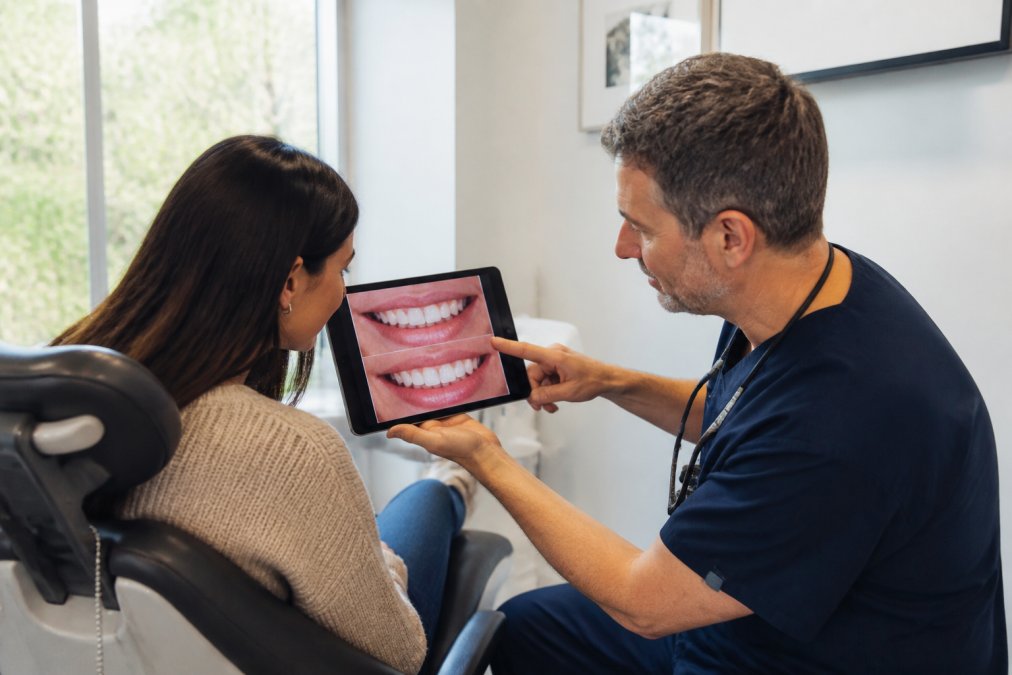
The platform analyzes the patient's current smile, facial structure, and aesthetic goals, then generates a photorealistic preview in seconds. The AI learns from thousands of successful smile transformations to predict outcomes specific to each patient's anatomy.
Patients see their transformation immediately, eliminating the "think about it and call us back" objection. The visualization is precise enough that patients trust it represents what they'll actually receive, boosting case acceptance.
Patients who see their smile transformation chairside are significantly more likely to move forward with treatment that day.
The 3Shape TRIOS is the gold standard for capturing digital impressions in cosmetic dentistry, delivering high-precision 3D data for smile design, treatment planning, and lab communication.
The scanner captures detailed soft and hard tissue data in real time with AI-powered cleanup that removes artifacts automatically, meaning fewer rescans and faster workflow progression.
In complex cases, TRIOS data feeds directly into digital smile design software, surgical guides, and lab milling systems. Built-in margin detection and shade measurement eliminate guesswork.
The tradeoff is cost and ecosystem lock-in. For high-volume cosmetic practices, the investment pays for itself quickly; for smaller practices, ROI is tighter.
CEREC Primescan enables single-visit smile makeovers by pairing with Primemill, allowing you to scan, design, mill, and seat restorations without lab work.
Dynamic depth scan technology captures fine detail in deep cavities and margins, ensuring predictable margin fit. Design software integrates directly with the mill, reducing chair time between scan and restoration.
For practices offering single-visit smile transformations, the ability to mill multiple restorations in sequence makes the patient experience seamless.
The limitation is ecosystem lock-in. It's powerful for single-visit workflows but less flexible for complex multi-discipline cases requiring external lab work.
The Medit i900 features a touch-control interface that allows hands-free navigation, reducing clinician fatigue during longer scanning sessions.
AI algorithms learn from scan patterns to optimize data capture automatically, meaning fewer manual adjustments and faster workflows.
The lightweight design and intuitive touch interface make this scanner comfortable for multiple cases in sequence, with frequent software updates delivering algorithm improvements.
The tradeoff is learning curve; most teams report comfort within 1-2 weeks of regular use.
Shining 3D Aoralscan Elite offers an accessible entry point for practices entering digital dentistry, delivering solid accuracy at lower capital investment than premium alternatives.
The scanner handles core functions well: high-accuracy 3D capture, integrated AI for automatic optimization, and open file export that works with most third-party design software.
The user interface is straightforward; most clinicians become proficient within days without extensive training.
Processing speed is the limitation; Aoralscan Elite processes data slightly slower than premium scanners. For low-volume practices this is negligible; for high-volume operations, premium scanners' speed advantage compounds.
Digital dentistry tools only increase case acceptance when integrated into a clear consultation workflow that addresses emotional confidence and practical value. You need a process that moves patients from "interested" to "committed" by showing them what they'll get and why the investment makes sense.
The most effective approach combines smile visualization with digital impressions and treatment planning, supported by a patient-centric ROI conversation. Patients who see their transformation become emotionally invested.
The Patient Value Conversation: Time, Durability, and Cost
Chair Time Reduction: Digital workflows reduce total chair time by 30-40% compared to traditional methods. A full-mouth makeover using digital impressions, same-day milling, and integrated treatment planning typically requires 2-3 appointments versus 4-6 for traditional workflows. For working patients, this time savings is worth premium pricing. Frame it this way: "Your smile transformation takes two appointments instead of five, meaning you take less time off work and get your new smile faster."
Restoration Longevity and Durability: Restorations designed from digital data and fabricated using CAD/CAM milling show measurably longer clinical survival. Digitally designed veneers typically last 12-15 years; traditionally designed veneers average 8-10 years. This durability difference means patients get more value per dollar spent. Calculate the cost-per-year: a $1,200 veneer lasting 15 years costs $80/year; the same veneer lasting 10 years costs $120/year. Patients who understand this durability advantage see the higher upfront investment as cost-effective over time.
Predictability and Reduced Remake Risk: Digital workflows eliminate the "surprise" factor. When patients see their smile in the chair before treatment, and restorations are designed from precise digital data, remake rates drop to near zero. Traditional workflows carry a 5-10% remake rate due to impression errors, shade miscommunication, or fit issues. Communicate this as a guarantee: "With digital design and precision milling, we eliminate the risk of remakes. You see your smile before we start, and what you see is what you get."
Step 1: Initial Assessment & Visualization (5 minutes) Show the patient their current smile and the simulated transformation using digital smile design software. This is the emotional hook that makes everything else possible.
Digital dentistry tools for smile makeovers serve one primary purpose: they eliminate the gap between what patients imagine and what they'll actually receive. The tools that do this most effectively combine visualization, precision, and workflow efficiency.
Digital smile design tools like SmileViz show patients their future smile in real time during the consultation, transforming an abstract conversation into a concrete visual. When patients see their potential results before committing, acceptance rates increase significantly because they understand exactly what to expect. This immediate visualization eliminates doubt and turns the consultation into a closing opportunity rather than just an information gathering session.
AI-powered smile simulation software like SmileViz focuses on patient visualization and case acceptance during consultation, generating realistic previews in seconds. Intraoral scanners like 3Shape TRIOS and CEREC Primescan capture digital impressions for treatment planning and restorations. Both are essential: scanners provide the clinical data needed for treatment, while simulation software convinces patients to say yes. Many practices use them together for a complete digital smile design workflow.
For practices doing 3-4 cosmetic cases monthly, the ROI depends on case value and acceptance rates. AI-powered smile simulation tools directly increase case acceptance, meaning fewer consultations are needed to close the same number of cases. Even small practices benefit from reduced consultation time and higher-value case closure. Calculate your average cosmetic case value and acceptance rate improvement to determine payback period. SmileViz offers flexible pricing and a free trial to test viability before full commitment.
Modern tools like SmileViz are designed for rapid adoption, with chairside simulation tools requiring minimal training since they're intuitive for patient-facing use. The key is choosing systems with user-friendly interfaces and strong onboarding support. Many vendors provide video tutorials and live training to accelerate your team's competency.
Get started with SmileViz and transform how your practice closes cosmetic cases. The platform's AI-powered smile simulation shows patients their transformation in seconds, directly from the chair. See how practices using SmileViz increase cosmetic case acceptance and turn consultations into commitments. Book a demo today to experience the difference visualization makes.
Show patients their future smile in about 90 seconds and close more cosmetic cases chairside.
Book a free demo
AI smile previews that help patients say yes, before, during, and after the consult.